“Who is God?” by Apologia Press
Posted by jlsgrant in Book & Product Reviews on March 15, 2011
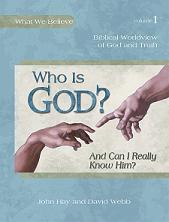 We have been so blessed by “Who Is God,” by Apologia Press. But we before we get further into our opinion, let me give you a little background on this product:
“Apologia has teamed with Summit Ministries to bring you the “What We Believe” Series. The “What We Believe” Series is an outstanding way to teach your child the essential beliefs of the Christian faith, but it’s so much more! With this student-directed, Bible-based curriculum, your children will learn how to use Scripture as a lens through which to view the world around them—to see everything the way God sees it—and know the truth.”
Who is God? And Can I Really Know Him?, the first book in the series on Biblical Worldview, introduces the concept of Worldview and lays a foundation for Christian truth through Scriptural references, storytelling, scripture memorization, and guided journaling.
The basis for this study is something we are all too familiar with: “Our children are bombarded on a daily basis with competing messages. Every song, movie, book, TV show, blog, and game is full of ideas—ideas about truth, morality, beauty, identity, faith, and more. Not all of these ideas are true. Some are wrong, some are deceptive, and some are outright destructive. It is more important than ever that young children be equipped to discern among competing ideas and stand in the truth.”

So what are our thoughts about it? Simply this:
LOVE IT!! 🙂
We have been using this book to begin our school day since we received it and have all truly enjoyed this study. Who Is God? is full of Godly truth and each and every concept is backed up with Scripture. The kids (11 and 15) say they are enjoying it because, “it makes them think!” 🙂 The short stories really help bring the concept to life.
I enjoy it because, in addition to the wonderful content, there is not a lot of prep time involved for the teacher. In fact, there is no reason they could not do this independently. Each section has thought provoking questions for discussion. There are ten lessons in the book, which can be completed in one to two weeks, depending on the amount of time spent journaling and working on the memorization. 
We will continue using this study throughout the school year and look forward to using the second book in the series, Who Am I? And What Am I Doing Here?, next year.
What a wonderful way to start the school day!

This Product and Others Available from:

Link to: Sample Lesson & Table of Contents
Cost: $39.00
Age: 6 – 14 years
Product Type: Student Directed Learning/Minimal Teacher Prep
Check out the FAQ page for more information on teaching Worldview
Coming Soon…..
Who Is My Brother? And Why Do We Need Each Other? Available 2011
What on Earth Can I Do? Available 2012


Disclaimer: Members of the TOS Homeschool Crew were given copies of this book in exchange for their honest review. No other compensation of any kind has been received. Quotes in this post are from the product website, with the exception of the quote from my kiddos.
Share this post

Apologia Biology: Module 12 – Phylum Arthropoda
Posted by jlsgrant in Apologia Biology, Life Lessons/Inspiration on March 6, 2011
Phylum Arthropoda is home to some of my least favorite creatures….spiders and centipedes. Oh they’re OK outside, but please stay out of my territory! That’s all I’m saying! However, in all fairness to this Phylum, it is also home to Shrimp Cocktail, Coconut Shrimp, King Crab Legs, and Crayfish Etouffe’.
Class Crustacea
This week’s class focused mainly on Experiment 12.1 – Crayfish Dissection. Applie took some great pictures of her Crayfish Dissections, so be sure to check out her blog.
Class Arachnida –
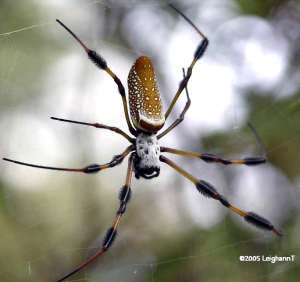 While, as admitted, this is not my favorite creature, they are an amazing group! When we first moved into our house, we had a huge banana spider take refuge just outside our dining room window. It was amazing to watch her spin her web and catch insects. She was quite beautiful in her own way. At night, in the light of a nearby street light, the web made cool, yet creepy shadow on the dining room wall! One day the “bug guy” came to spray and I ran outside to tell him not to kill the spider! He said that was a first! 🙂 After several weeks, Charlotte got a little greedy, trapped and ate a dragonfly, and promptly fell to the ground dead! (Photo courtesy of Photobucket.com)
That ends my tale, but check out these interesting videos….
NOVA Series Examines Strength of Spider Silk
Look at this…a Trap Door Spider…
Ever wonder, How do spiders make their web?
Here is an interesting art project: Spider Web Art Project
Class Insecta
Of the many things to learn about Class Insecta, and perhaps the most beautiful is the metamorphosis from egg to larva, to pupa, to adult. Surprisingly, a majority insects go through this type of process. AMAZING! We have had the privilege of watching the metamorphosis of the Monarch, and other butterflies, over and over in our own backyard.

I cannot observe this process without being reminded of our own metamorphosis. Romans 12:2 says, “and do not be conformed to this world, but be transformed by the renewing of your mind, so that you may prove what the will of God is, that which is good and acceptable and perfect.” (NAS) The only other time this word is used in the Bible is in the transfiguration of Christ, mentioned in all four gospels! Brings a little depth to our own metamorphosis, doesn’t it? Have we undergone a complete metamorphosis, changed to an entirely new creature? Or are we stuck in the larval stage?
The remaining time in class was spent observing some very interesting insect collections; one contained many local species and the other was a collection of insects from Thailand. Because of time limitations, for Experiment 12.2 – Insect Classification, we used the specimen in the textbook for our project.
A couple of ideas to throw in the pot: 1) Have each student do a virtual insect collection of 10 – 20 local species, print pictures and make scrapbook-like pages for their notebooks, journal their identifications and 2) Have each student bring one or two live specimen in a jar for the class to identify and observe.
Study Link: Flashcards & Games at Quizlet.com
Share this post


One Word


 Mindful Ramblings