Vocabulary Cartoons: SAT Word Power
Posted by jlsgrant in Curriculum Reviews on September 17, 2010
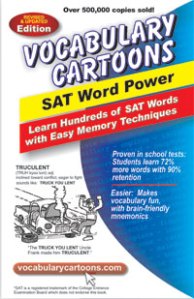
The Vocabulary Cartoons series uses mnemonic memory techniques to learn vocabulary. Simply put, by associating a word with something familiar, the words are locked in place quicker. The books use pictures and rhyming words to facilitate this process. There is an old Chinese proverb which says, “What you see once is worth what you hear a hundred times.” Translated into English, that proverb became, “A picture paints a thousand words.” If you combine that with silly rhymes and crazy pictures, you get Vocabulary Cartoons!

Here are some quotes from the book and website:
“In recent years neuroscientists have uncovered astonishing facts about how the brain learns, stores, and retrieves information! The use of mnemonic applications is high on the list of the way the brain learns most naturally and efficiently.”
“Vocabulary Cartoons works on the principle of mnemonics. A mnemonic is a device that helps you remember something by associating what you are trying to remember with something you already know. A mnemonic device could be in many different forms like; rhymes, songs, pictures to name a few. For example, “Columbus sailed the ocean blue in fourteen hundred ninety-two” is a classic mnemonic rhyme which helps you remember when Columbus discovered America.”
“Following the mnemonic principle of association, Vocabulary Cartoons link together an auditory (rhyming) word association and a visual association in the form of a humorous cartoon. These powerful mnemonics help students retain the meanings of words longer and with less effort than trying to memorize definitions straight out of a dictionary.” Here are some examples from the books:

Students learn hundreds of SAT level words faster and easier with powerful rhyming and visual mnemonics. In independent school tests, students with Vocabulary Cartoons learned 72% more words than students with traditional rote memory study materials and had 90% retention. Contains 290 SAT words with 29 review quizzes consisting of matching and fill-in-the-blank problems.

I have been a huge fan of Vocabulary Cartoons for a couple of years now, so when TOS announced we would be reviewing the SAT Word Power edition, I couldn’t be more excited. I had already purchased a copy to use with my 10th Grader this year, along with the next book in the series, Vocabulary Cartoons II, SAT Word Power. I tend to be a very visual learner, so this is right up my alley! I still remember Guerilla Gorillas from a couple of years ago! The thought of gorillas with guns running through the woods is just hard to forget! That’s the idea of Vocabulary Cartoons. The kids have gotten more than a couple good laughs from the cartoon format, and I never have to remind them to work on their vocabulary.
Each of the 29 sections contain 10 vocabulary words followed by a one page review/quiz. The review contains 10 matching questions and 10 fill-in-the-blank questions. In addition to reviewing the words/cartoons daily, my daughter writes sentences for each word in the section. The last day of the week, she completes the review.
Here’s a link to the word list for this book: Vocabulary Cartoons: SAT Word Power

Without any doubts, I would give this book all five rocks! These books are fun and entertaining and can be used by the whole family. If you’re looking for a new approach to learning vocabulary, I would highly recommend Vocabulary Cartoons: SAT Word Power
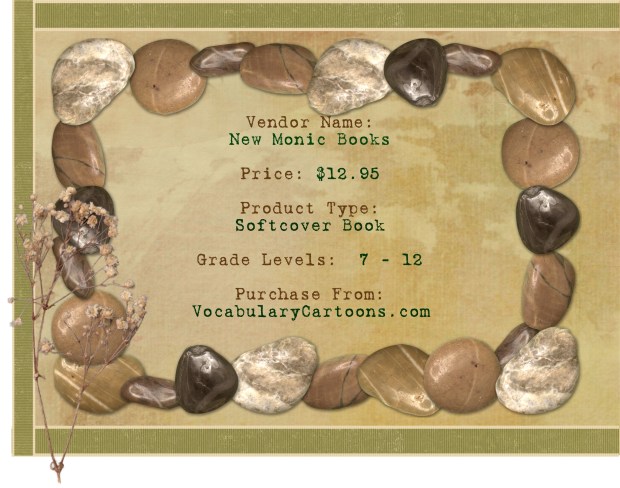
Other products available include, but not limited to:

For more reviews on this product head over to The Old Schoolhouse Homeschool Crew Blog at:

Disclaimer: Members of the TOS Crew were given this product for free to use with their family. In return, they were asked to post an honest, informational review on this product. No monetary compensation was received.
Share this post

Apologia Biology – Module 2
Posted by jlsgrant in Apologia Biology on September 14, 2010
The following websites have many microscopic images for Kingdom Monera & Kingdom Protista and may be helpful in identifying specimen you find in your experiments for Module 2 & 3:
You can take a look at Bacterial Cell Structure at Cells Alive. And don’t forget these for some interesting facts about bacteria: Bacteria, Friend or Foe?
From The Case for a Creator series:
We had planned to make collection our pond water a field trip, but because of our schedules and weather conditions, we were not able to pull it off. I, instead, trudged out to find our specimen with a brave friend. You can check out that adventure if you’d like: Apologia Biology – Pond Water, Part A, also know as Experiment 2.1….collecting pond water in Florida does take a bit of courage!
Pictures & Notes from Experiment 2.2
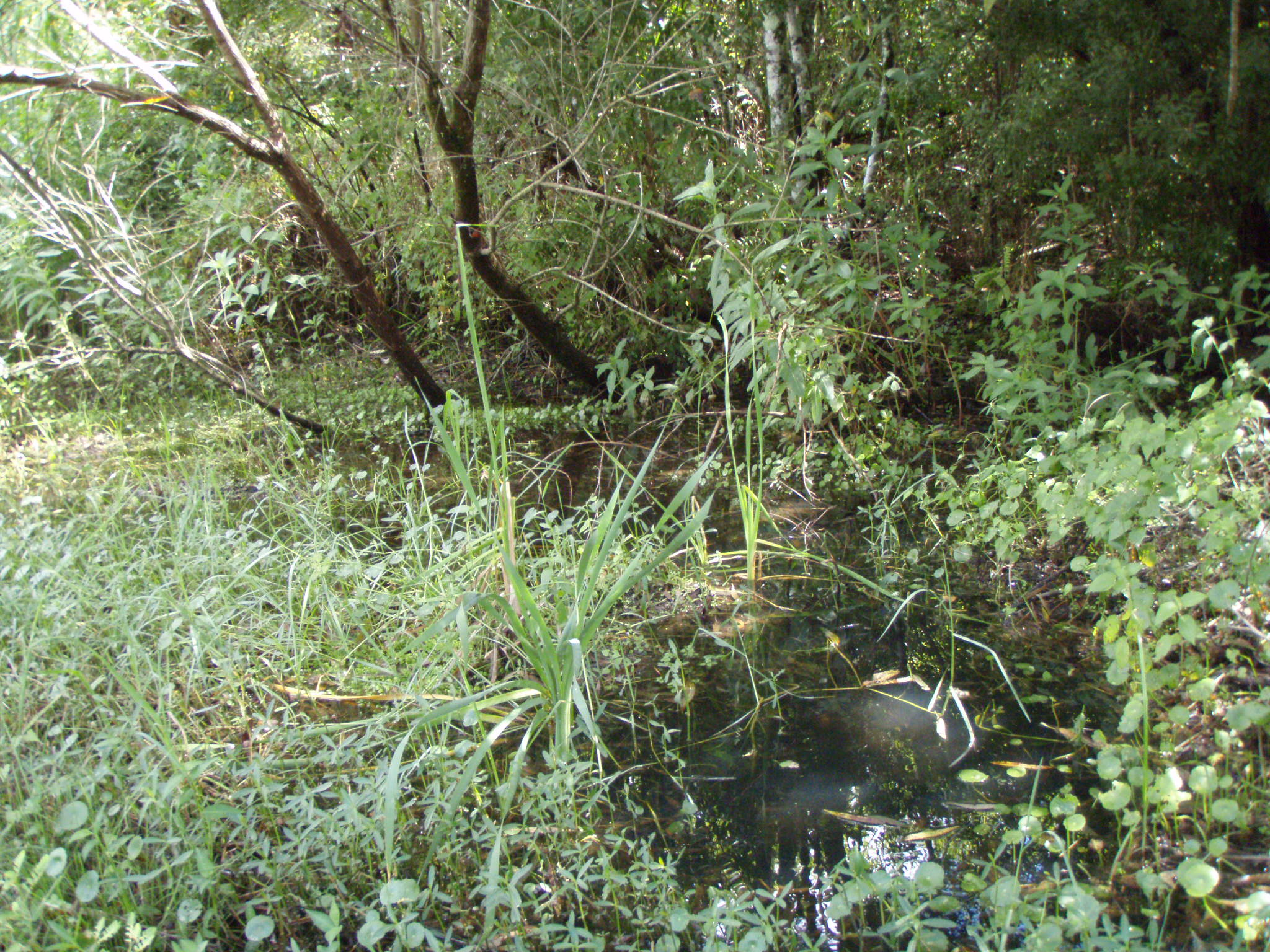
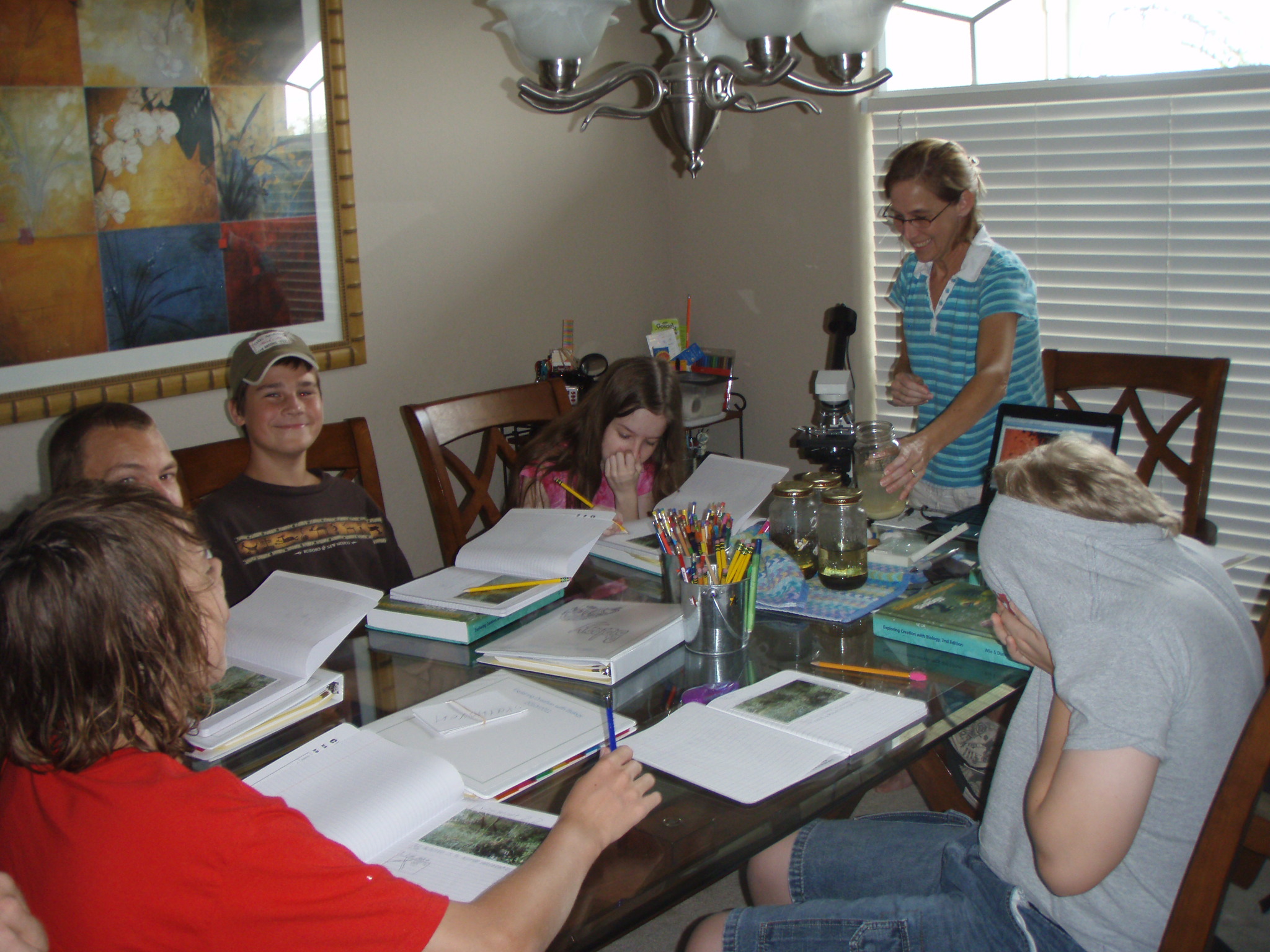
Here is the pond where we collected our samples. As you can see it is a very wild, wooded area, more of a wetland area, then a pond. The water was teeming with minnows and frogs and there are often turtles in the area. Our Co-Op class fell on the 3rd day following collection, so we did not see a huge amount of activity. The samples, however, smelled quite ripe!
Here are the two best images we got from the day:
Specimen #1
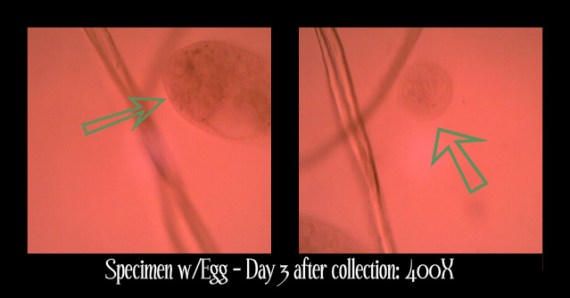
We saw movement in the specimen with the egg and the specimen with the dried grass, but unfortunately couldn’t find anything moving in the other two specimen. (The long strands are fibers from the cotton we used.)
While it was not a class day the following day, I decided that it would be a good idea to check our specimen the following day since the population should reach it’s peak between day three and day five. There was a huge difference in the population. (See Figure 2.5 in your textbook for a chart about this exponential growth.) Here are some images for you to identify using your textbook. (There are pictures on pages 61, 62, and 69. If you can’t find them there, you can also check Dennis Kunkel Microscopy.)
Specimen #2
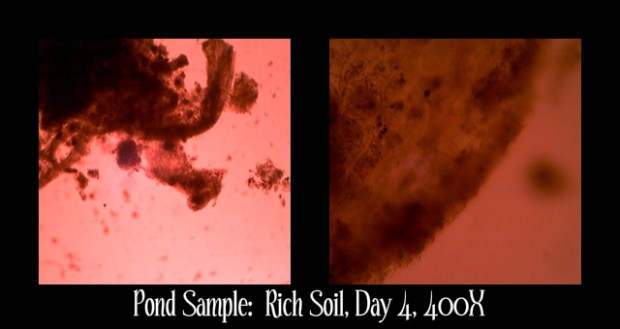
Specimen #3 – first image, long thin specimen could be a Diatom
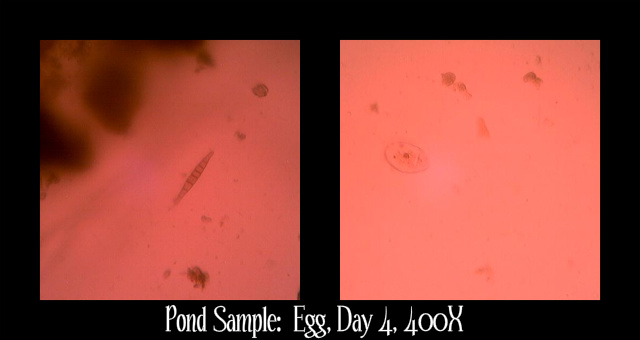
Specimen #4
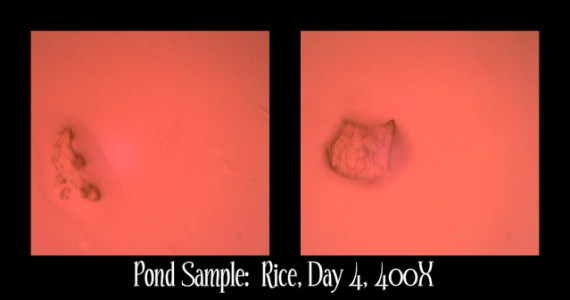
Specimen #5 – Both images look to have Amoeba, 2nd images may also have either a Rotifer or some kind of insect larva

Specimen #6 – First image, Amoeba

I was able to get a video capture from the specimen with the egg, but I need to figure out how to re-format it in order to upload. I did not post the identification for the above specimen, but would love your feedback on what you think it is.
Study Link: Module 2 Flashcards
Share this post


One Word


 Mindful Ramblings