Archive for category Apologia Biology
Apologia Biology: Module 6, The Cell
Posted by jlsgrant in Apologia Biology on October 29, 2010
Yikes! The complexity within a single, microscopic cell is amazing! In fact, it is so complex, that Module 6 has 45 vocabulary words to learn! But don’t be overwhelmed.
Try to compartmentalize the words into groups and pay close attention to root words, prefixes and suffixes wherever you can. Completing your cell illustration will help; label cell parts, then describe the function. (You will need that for your edible cell project!) To further compartmentalize, look at similarities in the words. For example the following words have the suffix, -tion, meaning a process of:
absorption, disgestion, respiration, excretion, egestion, secretion,
reproduction, secretion vesicle
Look at the following words and see how they are inter-related; all of them contain -plasm:
plasma membrane, cytoplasm, cytoplasmic streaming,
endoplasmic reticulum, plasmolysis
To go along with that did you know the prefix endo-, means within? (You may come across that again with other words in the course.) The suffix -lysis means to break down.
INTERMISSION….
Found these young men rapping about the parts of an animal cell and their functions:
Here are a couple of links that go along with the study of cells:
Explore this 3-D Cell courtesy of Queen Mary University of London
The Incredible Edible Cell project courtesy of ScienceSpot.net
This next post includes pictures of our Incredible Edible Cells! Module 6: Experiments (Microscopic Images and Video)
Study Link: Flashcards & Games at Quizlet.com
Disclaimer: No compensation of any kind has been received for promoting the websites and links contained in this post.
Share this post

Apologia Biology: Module 5
Posted by jlsgrant in Apologia Biology on October 23, 2010
 Sorry, no microscope this week! But we did have quite a bit of fun! At home we enjoyed Experiment 5.2 on Osmosis! Watching osmosis in action was very interesting as we learned about semi-permiable membranes using eggs.
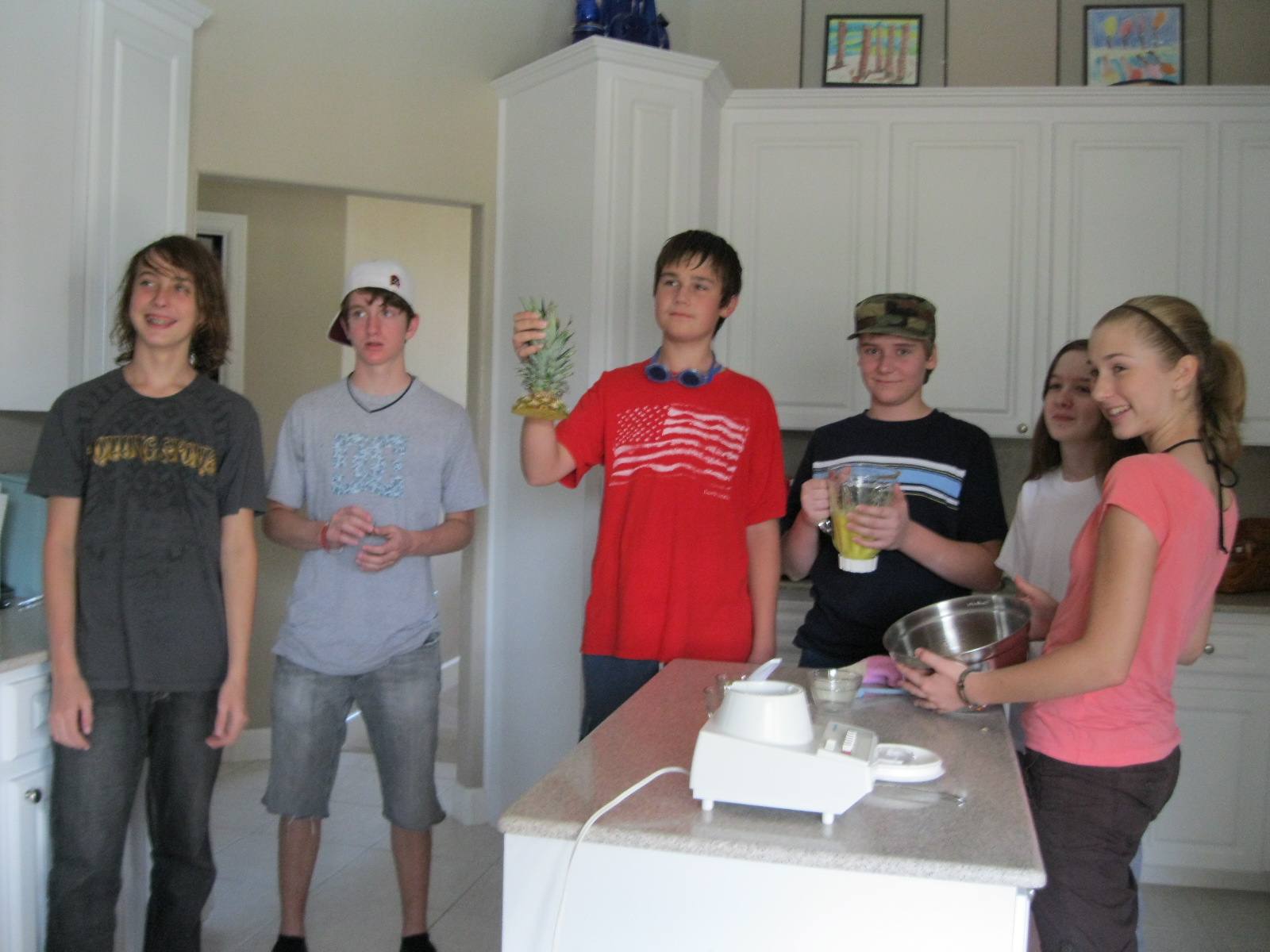
During our Co-Op session, we completed Experiment 5.3, The Fragility of an Enzyme. It answered an age old question for me! I remember when I was young, asking my mom to add some pineapple to the jello she was making. She told me you couldn’t put fresh pineapple in jello because it wouldn’t set up!

I always wondered why, until Experiment 5.3!! It was great doing an experiment in the kitchen, and quite nice to be able to eat your experiment when you’re done….
While our jello experiment was setting up completing it’s enzymatic breakdown, we headed out to the pool deck to work on our edible DNA molecules. Who knew DNA could be so fun? I, for one, had no idea DNA could have so much sugar! (The Edible DNA project is courtesy of The University of Utah.) You can, indeed, have your DNA and eat it too! It seemed to be our day for edible experiments! It was good we had some extra Twizzlers, because the group felt it would be wrong to build a molecule with a crooked backbone. Any “imperfect” backbones had to be sacrificed for the sake of the perfect molecule!
The students were very industrious, carefully joining pairs of Adenine and Thymine, and Cytosine and Guanine to form the perfect double helix! The whole project took about half an hour to complete.
The modules of this course can be very intense because of all the vocabulary, so it’s always a good idea to have some fun while you’re learning, even if you are a High School student! Since Experiment 5.3 was not yet ready to be evaluated, we all agreed we should go for a swim study the vocabulary terms for the test.
To review the 25 new terms for Module 5, we played a little game…in the pool of course! The game is called The Underwater Vocabulary Game, but may more accurately be named “Vocabulary Splash”, or even “Oh No, The Skimmer Ate Polysaccharides!” (Note: Click the title to get a copy of the rules of play!)
And we’re on to Module 6!
Share this post

-
You are currently browsing the archives for the Apologia Biology category.

One Word


 Mindful Ramblings