Spicebush Swallowtail
Butterflies apparently love September in Florida! Who doesn’t? Not that we don’t see them pretty much all year, but there have been a lot of Monarchs laying eggs and caterpillars chowing down on what’s left of the milkweed.
We’ve also been keeping an eye on the Camphor Tree outside the Family Room window. The other day, as we were reading Charles Dickens’, Great Expectations, we noticed a Spicebush Swallowtail visiting the tree. Up until today, we have seen no trademark curled up leaves. Tonight when we got home, I thoroughly inspected it again and found this little guy:

He’s only about 1/2 inch in length now, but hopefully we’ll be able to track him through the rest of his metamorphosis. I’m sure not many of you have a favorite caterpillar, but this one is mine! I know, I’m a bit of a geek when it comes to nature! But let me show you what happens next…..
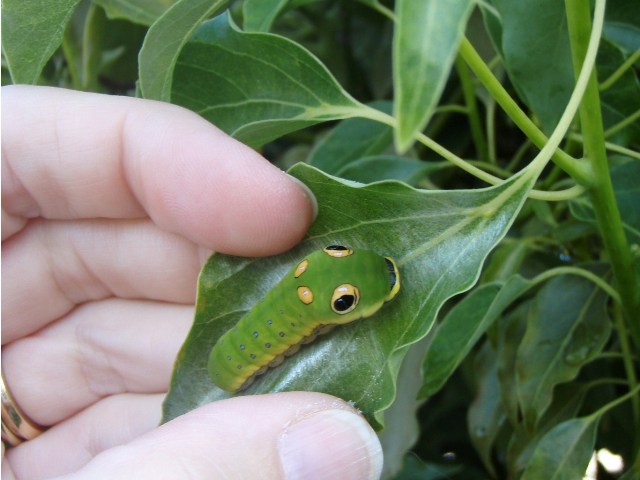
OK…see what I mean? What’s not to love, right? And those eyes? Not real! (They’re just there for disguise!) And if that’s not enough, try the next stage….

Before they move on to the chrysalis stage, they turn orange! Incredible, right??
Share this post

Apologia Biology: Module 3
Posted by jlsgrant in Apologia Biology on September 18, 2010
Module 3 – “Kingdom Protista”
I was excited to find these wonderful websites this morning! These will further assist you with your identification of the specimen found in your Pond Water samples.
The Microscopy-UK website is home to “The Smallest Page on the Internet”. There is an awesome collection of microscopic image for Kingdom Monera and Kingdom Protista on both of these websites:
There are also many video captures of Amoeba, Paramecium, Diatoms, etc on YouTube.com….I chose just a couple, but by doing a search for the organism you will find many videos of the species we ‘re studying:
Experiment 3.1
For some reason, I assumed that today we would be looking at mostly dead organisms! After all, our odorous specimen have been living outside on the pool deck in the heat, trapped in a jar for almost two weeks! There were some incredible creatures to be seen, but it took time and patience to find the good stuff. While I was searching, a couple of verses came to mind; One being, “Be still and know that I am God.” (Psalm 46:10) For if I had tried to rush through the slides to get them all done, we would have never discovered many of the following “critters”. The other thing I thought about is the old proverb that says, “Good things come to those who wait!”
I wish you all could have been here to see this in person:
Object: To see if other organisms could be found in the original pond samples from Module 2. Click on images to get a larger view.
Specimen #1 – Pond Sample w/Egg
Specimen #2 – Pond Sample with Rice
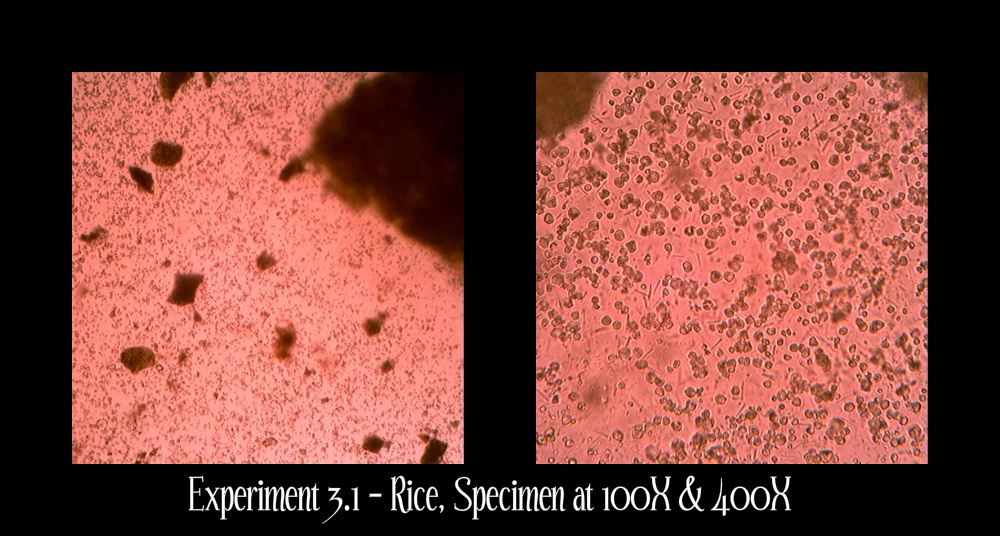

Circular specimen above may be a Diatom (Kingdom Protista, Subkingdom Algae, Phylum Chrysophyta), I think Puncticulata (species) …see thislink
Specimen #3 – Pond Sample with Rich Soil
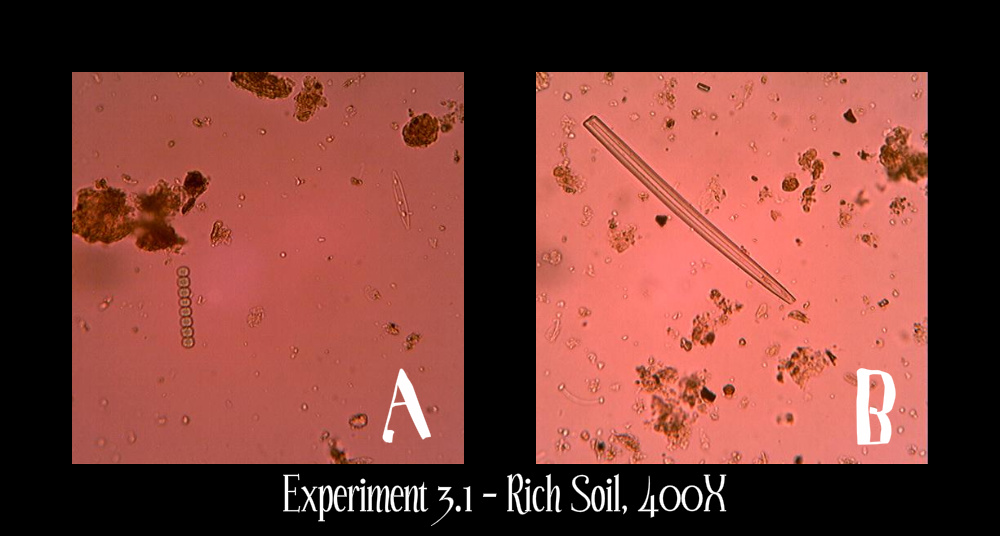
The green, Very Hungry Caterpillar-looking, specimen in Frame A, may be a Blue-Green Algae or Cyanobacterium called Anabaena (Kingdom Monera) or a colony of Desmid (Kingom Protista, Phylum Chlorophyta). The long, thin specimen in Frame B is a Diatom. (There are several other diatoms in that image.)
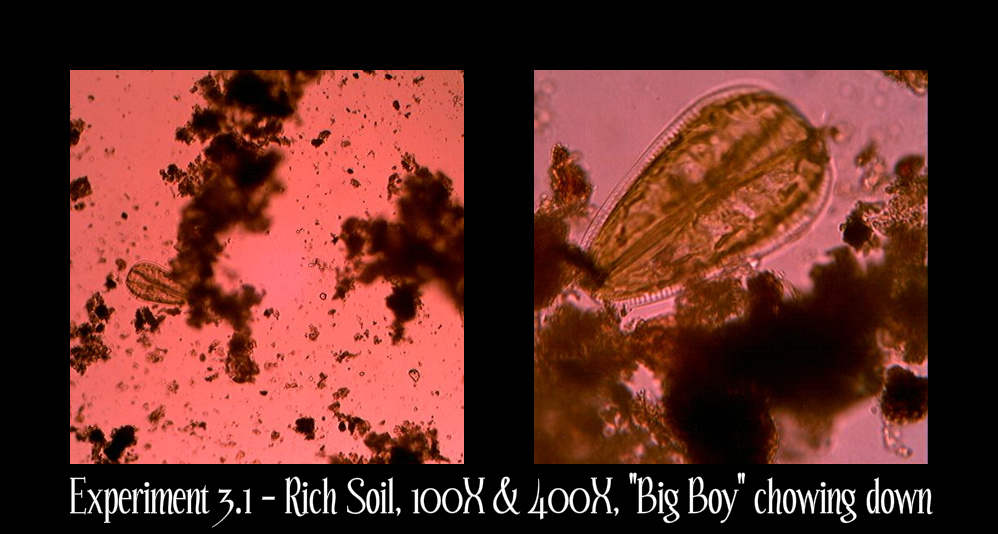
Per Wim at Microscopy-UK, our “Big Boy” is actually a diatom, probably a Surirella species. A very cool image of his Surirella can be found on display at theMicropolitan Museum. You can watch its movements in this feature film I put on YouTube:
Specimen #4 – Pond Sample with Dried Grass

Frame A shows a centric diatom and the paramecium (Kingdom Protista, Subkingdom Protozoa, Phylum Ciliophora) from Frame B at 100X. In the email from Wim, he identifies our friend in the glasses as a paramecium species known as Stylonchia. Wait until you see his image at the Micropolitan Museum! Incredible, right? See if you can identify the structures we observed in Experiment 3.2, Part B. In the video below, which is from our experiment, you can see its movement and watch the contractile vacuole doing its job!
Feel free to post your identification as a comment below, be sure to note Specimen # and Image Letter. Who knew Biology could be so much fun!
Study Link: Flashcards & Games for Module 3 on Quizlet
Share this post


One Word


 Mindful Ramblings